


Introduction
Foundation Revisited: Updated Tools and Guidance for Nutrition Practice Webinar
- Mr. Carl Vincent Cabanilla, PFT,RCh
- Mr. Han Yin Leong
- Mr. Robbie Aligada
The Nestlé Nutrition Masterclass, in partnership with the Nutritionist-Dietitians’ Association of the Philippines Foundation, Inc. (NDAPF), successfully conducted the webinar “Foundation Revisited: Updated Tools and Guidance for Nutrition Practice” on July 24, 2026, via Zoom, with 202 participants.
The webinar provided participants with updated perspectives on nutrition guidelines, Philippine nutrition tools, front-of-pack nutrition labeling, and food marketing to children—key areas shaping contemporary nutrition practice. The sessions highlighted the importance of translating current evidence and global developments into practical, locally relevant, and evidence-based approaches for nutrition professionals.
An open forum further encouraged meaningful exchange between participants and resource persons, addressing emerging concerns in nutrition practice, including food environments, nutrition policy, artificial intelligence, and the role of nutrition professionals in providing reliable, evidence-based information.
Through “Foundation Revisited,” the Nestlé Nutrition Masterclass continues to support professional learning by providing opportunities for nutrition professionals to stay informed, engage with experts, and strengthen the application of evidence in practice.
From Guidelines to Practice: Global Shifts in Nutrition Models and Updates in Philippine Nutrition Tools
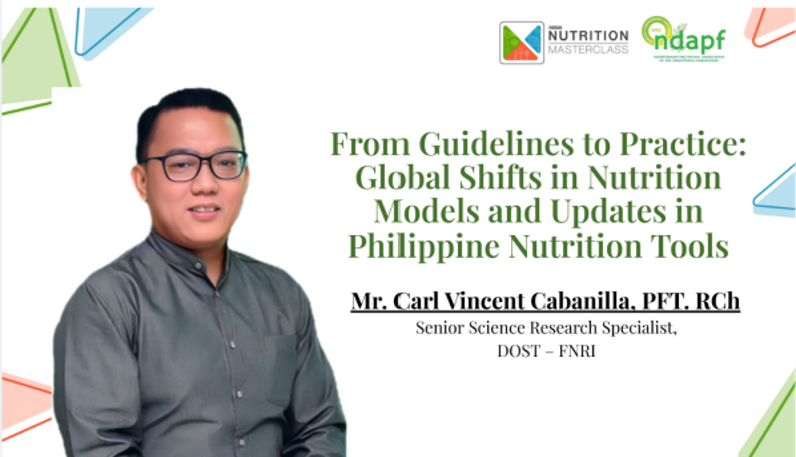
How do global nutrition recommendations become relevant and actionable for Filipinos?
Nutrition guidance continues to evolve alongside changes in the global nutrition landscape. From addressing nutrient deficiencies to promoting lifelong health, sustainable diets, and the prevention of diet-related noncommunicable diseases, dietary guidelines are increasingly shaped by emerging evidence and changing public health priorities.
In this session, Carl Vincent Cabanilla, Senior Science Research Specialist, discusses the major shifts in dietary guidelines and how global recommendations are translated into locally relevant Philippine nutrition tools that support nutrition assessment, planning, policy, programs, and professional practice.
Key Takeaways
- Dietary guidelines must evolve with emerging evidence and changing nutrition challenges.
- Healthy dietary patterns are increasingly prioritized over a focus on individual nutrients.
- Nutrition guidance now extends beyond deficiency prevention to lifelong health and NCD prevention.
- Sustainability and planetary health are becoming important considerations in dietary guidance.
- Evidence-based methods strengthen the development and updating of nutrition recommendations.
- Global recommendations must be contextualized to the Philippine setting.
- Philippine nutrition tools translate scientific evidence into practical guidance for Filipinos.
- The effectiveness of guidelines ultimately depends on their implementation in policies, programs, professional practice, and everyday food choices.
Nutrition guidelines are not the destination; they are the roadmap.
Their true value lies not simply in the recommendations themselves, but in how they are translated into action—shaping policies, guiding professional practice, empowering healthier choices, and ultimately improving the nutritional well-being of Filipinos.
Front-of-Pack Nutrition Labeling: Global Evidence and Emerging Directions for the Philippines
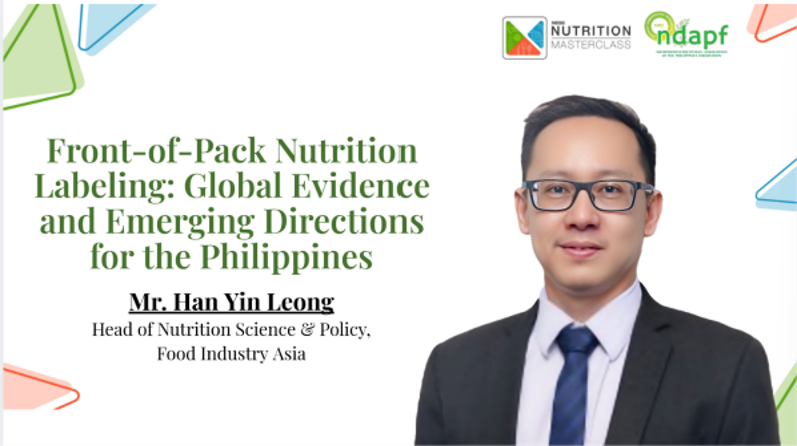
How can front-of-pack nutrition labelling help consumers make informed food choices—and what can the Philippines learn from other countries?
Front-of-pack nutrition labelling (FOPNL) provides simplified nutrition information on the front of food packaging to help consumers understand the nutritional value of products and make informed purchasing decisions. In this session, Han Yin Leong, Head of Nutrition Science & Policy at Food Industry Asia, examines the global evidence surrounding different FOPNL approaches and their potential application in the Philippine context.
The session explores evidence on how different labelling systems can improve consumer understanding, purchasing decisions, and product reformulation, while emphasizing that FOPNL should not be viewed as a stand-alone solution to complex nutrition challenges. Its greatest potential is achieved when combined with consumer education, healthier food environments, product reformulation, and supportive policy measures.
Key Takeaways
- FOPNL simplifies nutrition information and helps consumers identify healthier choices.
- Different FOPNL systems serve different purposes, from nutrient-specific information to overall health indicators.
- Simple, interpretive labels improve consumer understanding, while evidence on long-term health outcomes remains limited.
- Consumer preferences matter: 64% of surveyed Filipino consumers reported that nutrition information influences their purchasing decisions.
- FOPNL should reflect local context, supported by evidence-based nutrient profiling and Philippine dietary priorities.
- Effective implementation requires collaboration, consumer education, monitoring, and continuous policy refinement.
Effective FOPNL is more than a label—it is part of a broader approach to creating a food environment that enables healthier choices.
Regulating Food Marketing to Children: Approaches and Implications for the Philippines
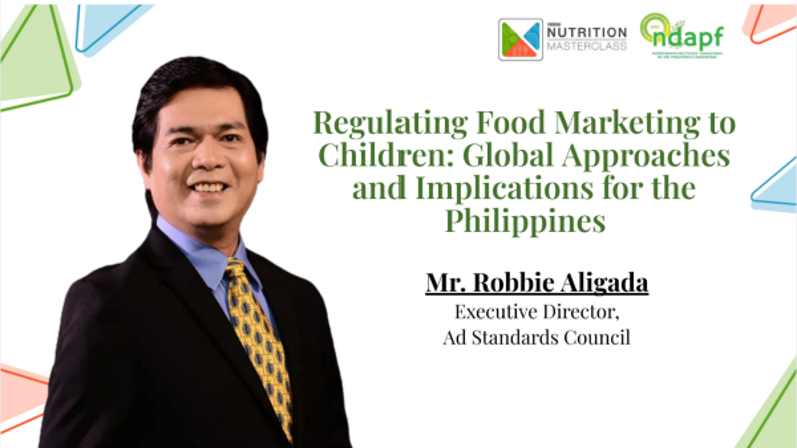
How can responsible marketing help protect children while supporting families in making informed food choices?
This session by Robbie A. Aligada of the Ad Standards Council (ASC) explores the principles of ethical and responsible advertising to children, with a focus on protecting children’s welfare while recognizing the role of parents, industry, government, and other stakeholders in shaping healthier food environments.
Key Takeaways
- Children can influence household purchasing decisions, making responsible communication particularly important throughout the consumer decision-making process.
- Responsible advertising should be fair, decent, truthful, and respectful, with the child’s ultimate interest and welfare as a primary consideration.
- The 2026 Philippine Responsible Advertising to Children Principles define children as individuals 12 years old and below and establish distinctions between child-directed and family-oriented advertising.
- Non-compliant products should not use child-directed marketing, including child-appealing characters, influencers, language, animation, or direct calls to action targeting children.
- Family-oriented advertising should provide factual nutrition information, target parents as decision-makers, and promote healthy lifestyles and moderation.
- Social media advertising requires particular attention, including restrictions on influencers under 18 and the need for content to remain family-oriented rather than child-directed.
- Self-regulation and stakeholder dialogue are essential to keep advertising practices responsive to emerging concerns, regulations, and the protection of children.
Responsible marketing is a shared responsibility. Protecting children requires ethical advertising practices, informed parents and consumers, responsible industry participation, effective regulation, and continued collaboration among stakeholders.



No comments here yet.